Application Note
Practical and safety considerations when splitting the output from one constant current stimulator
Introduction
We regularly receive enquiries from users of our isolated constant current stimulators, asking whether it is acceptable to split or divide stimulator output in human research studies. This is often because the user wishes to stimulate more than one distinct location at the same time. In this post we explain why this is not generally recommended, primarily because the user has reduced control over the current flowing through each set of electrodes but also because it can introduce serious safety hazards.
It’s all about Ohm’s Law
Any discussion of electrical stimulation theory often references Ohm’s Law and the same is true here. When a constant current stimulator is passing a stimulus through a single pair of electrodes, the stimulator makes use of the voltage available to pass the requested current through the tissue being stimulated. This is very simplistically illustrated in the figure opposite, where the current is set to deliver 100mA through a pair of electrodes that have a combined resistance of 2kohms. As a result, the stimulator will use 200V to pass the requested 100mA.


Current flow with equal electrode resistances
If the stimulator output sockets are split so the current is divided between two pairs of electrodes in distant locations, this can be crudely modelled as a pair of resistors connected in parallel to a single current source. Therefore, if the total resistance of electrode pair is identical, for instance 2kohms, the current flowing through each will be exactly half of that set on the stimulator i.e. 50mA and the voltage required to pass the total current of 100mA will fall to 100V.
Current flow when electrode resistances are unequal
If there are any differences between the electrode resistances, the current flow will become unbalanced and one site may be exposed to more current than the other. Assuming the available compliance voltage of the stimulator is not exceeded, the total current flowing from the stimulator will still match what is set on the stimulator controls, however, the current flowing through each pair of electrodes will be inversely proportional to the resistance of each electrode pair.
Returning to our electrical circuit theory again, the total resistance (Rt) of a parallel circuit that includes resistors of different values can be calculated from 1/Rt = 1/R1 + 1/R2 + R3…..), where R1, R2 and R3 etc.
In the image opposite, the stimulator is still set to 100mA but Rt is now 1.333kohms. The voltage output from the stimulator and passing through each electrode pair will be the product of Total Current and Total Resistance i.e. 133.33V and the current through each can be calculated using Ohm’s Law. If the electrode pairs have resistances of 4kohms and 2kohms, the current through each will be 33.33mA and 66.67mA respectively. Practically speaking, this means that while the stimulator is still delivering 100mA, the current the tissue is exposed to at each stimulation site will be different and uncontrolled were the resistances to change further.


What about potential safety issues?
Anyone carrying out electrical stimulation on human subjects must ensure there is no possibilty of current flowing trans-thoracically due to the risk of disrupting cardiac rhythm. This requirement is emphasised in the Precautions and Warnings section within our operator’s manuals. Where an isolated stimulator is being used with a single pair of electrodes, this simply means that the operator has to take care with electrode placement and ensure the heart is not located between in the current path between the stimulating electrodes.
When a user chooses to split the output from a stimulator to two or more pairs of electrodes, for instance placing a one pair on the left hand and one pair on the right hand of a subject, almost all the current will flow between the anode and cathode of each hand, but Ohm’s Law predicts that an imperceptible current can also flow across the body via the arms and thoracic region. However, as illustrated opposite, if any one of the electrodes on the hands was to become detached or a cable connection broken during stimulation, a significant and dangerous current path is created transthoracically. As a result of this risk, our stimulators should never be used for any applications where current could flow across the chest, either during normal use or in the event of an electrode detachment or cable failure.
How can I safely stimulate more than one site at the same time?
As discussed, use of a single stimulator for simultaneous stimulation of multiple sites gives the operator poor control of current flow at each site and depending on placement can be potentially hazardous to the subject. Therefore, when stimulating different locations where there a potential risk of transthoracic current flow, the most reliable and safest practice would be to use a dedicated isolated stimulator for each site or a multi-channel isolated stimulator. Because each stimulator provides a fully isolated current source, there is no risk of current flowing across the chest, even if an electrode was to detach or a cable break.
What about stimulating different sites at different times?
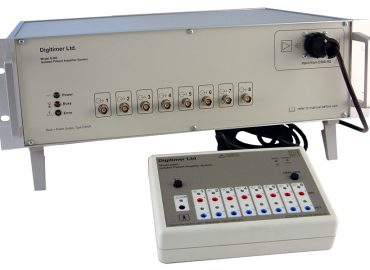
Where an application doesnt require simultaneous stimulation of more than one site, Digitimer’s Remote Electrode Selectors offer you a means to direct the output from one stimulator to multiple electrodes. Our D188 and D189 units allow digital inputs to switch between 8 discrete pairs of electrodes, while our new D187 Advanced Remote Electrode Selector can direct a stimulus to any configuration of up to 16 individual outputs, making it ideal for applications involving electrode arrays.