





Click to view your price request basket


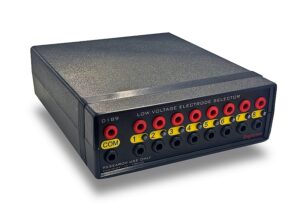
D185 MultiPulse Cortical Stimulator


1.  Can you confirm that the Digitimer D185 has now received clearance from the FDA for marketing in the USA?
2.  I see that the D185 has now become the D185 Mark II, what changes have been made to the instrument?
3.  I am intending to use the D185 Mark II with a  D185-HB3 electrode connection headbox for an upcoming scoliosis surgery but I was wondering how the polarity switches on the stimulator and the one on the D185-CB1 will interact with each other?
4. I am thinking of purchasing a D185 for intraoperative monitoring, what accessories is it necessary to purchase?

5.  As I want to continue to record SEPs while stimulating transcranially with the D185, I am worried that the stimulus artefact from the D185 will saturate my EP system inputs?  Is there any way to prevent this from happening?

6.  Recently, when testing a D185 MultiPulse, with an electrode extension cable I found that the stimulus was only passed intermittently in response to pressing of the front panel trigger button.  Do you think there a problem with the stimulator or cable?

7.  I have recently had problems with the error light coming on when I try and apply a train of many pulses at higher voltages.  Is there something wrong with my D185?


1.  Can you confirm that the Digitimer D185 has now received clearance from the FDA for marketing in the USA?

Yes, in October 2002 Digitimer announced that the D185 was approved for marketing by the FDA.  The D185 is now the ONLY device approved by the FDA for transcranial stimulation during intraoperative MEP monitoring.  Extensive use of the D185 all over the world has demonstrated that it provides a safe and effective way to reduce the incidence of paraplegia in spinal surgery or surgical cases involving temporary occlusion of spinal blood flow.  A press release is available on our website which provides further information.


2.  I see that the D185 has now become the D185 Mark II, what changes have been made to the instrument?

The new D185 Mark II now incorporates a number of enhancements which have been added in response to user feedback.  The front panel now includes a polarity reversal switch, a multi-turn control dial for setting the output voltage and rear panel switches to alter the trigger settings.  This latter feature means that the stimulator can be set up with  different EP systems without having to open the case and make internal adjustments.  Finally, the new model includes special circuitry to reduce stray mains (line) frequency pickup below perceptible levels.


3.  I am intending to use the D185 Mark II with a  D185-HB3 electrode connection headbox for an upcoming scoliosis surgery but I was wondering how the polarity switches on the stimulator and the one on the D185-CB1 will interact with each other?

When the D185 Mark II and the D185-CB1 are connected, both methods of reversing the stimulus polarity will operate.  For example if both the D185 and D185-CB1 are set to reversed polarity, then the output will have NORMAL polarity.  Digitimer suggest that if you are using the D185 Mark II along with a D185-CB1, you should leave the D185 front panel switch set to normal polarity (flick switch to the left) and only use the D185-CB1 to change it.


4. I am thinking of purchasing a D185 for intraoperative monitoring, what accessories is it necessary to purchase?

This is very much a decision that only you as the user can make, however we do supply a range of different accessories which start with the basic D185-HB4 which is essentially an output extension lead and end with the D185-HB3 which has 5 pairs of output sockets, a means of isolating SEP recording electrodes during MEP stimulus and a handheld trigger/polarity switching unit (D185-CB1) which allows the operator to easily trigger the D185.  More detailed information on the accessories is available on the main D185 page.


5.  As I want to continue to record SEPs while stimulating transcranially with the D185, I am worried that the stimulus artefact from the D185 will saturate my EP system inputs?  Is there any way to prevent this from happening?

Yes, the D185-HB3 was specifically designed with this problem in mind.  The D185-HB3 headbox incorporates 5 pairs of MEP output sockets as well as 6 channels of isolation for SEP electrodes.  If the SEP electrodes are connected through the D185-HB3, they are briefly isolated while an MEP stimulus is passed.  This prevents the EP system from "seeing" the MEP stimulus artefact and thus stops the amplifier from saturating/blocking for any length of time.  You can read more about the D185-HB3 on the D185 page.


6.  Recently, when testing a D185 MultiPulse, with an electrode extension cable I found that the stimulus was only passed intermittently in response to pressing of the front panel trigger button.  Do you think there a problem with the stimulator or cable?

Before you suspect any faults with the stimulator or cable, you should confirm that you have inserted the moulded plug of the extension cable correctly into the output socket on the front of the stimulator.  When the plug mates with the output socket, it can be partly inserted with very little force, however, this does not provide a good electrical connection.  For a complete electrical connection, further force is required and this supplement to the D185 users manual illustrates how the plug should be correctly inserted.


7.  I have recently had problems with the error light coming on when I try and apply a train of many pulses at higher voltages.  Is there something wrong with my D185?

The D185 has certain safety limits that prevent excessive energy from being delivered to the patient.  If you set the D185 to Normal mode and try to deliver too many pulses at too high a voltage, the unit will give an ERROR.  You should consult the section titled Operating Modes in the D185 Operator's Manual where you will find a graph that illustrated what these limits are.


HOME > SUPPORT > CLINICAL FAQ's > D185


[Latest News]    [Newsletter]    [Contact Us]    [Support]    [Search]   [Website Guide]    [Privacy]    [Company Information]

© 2008 Digitimer Limited - "Digitimer" and "NeuroLog" are registered Trade Marks of Digitimer Ltd.

Product Specifications are subject to change without prior notice